For the first time,
For the first time,
cold-chain operations in one digital platform

4 min read

Role

Role

Product Design

Product Design

Duration

Duration

Ongoing

Ongoing

Industry

Industry

HVAC-R

HVAC-R

Team

Team

3

3

Tools

Tools

Figma, Miro

Figma, Miro

About thallaja

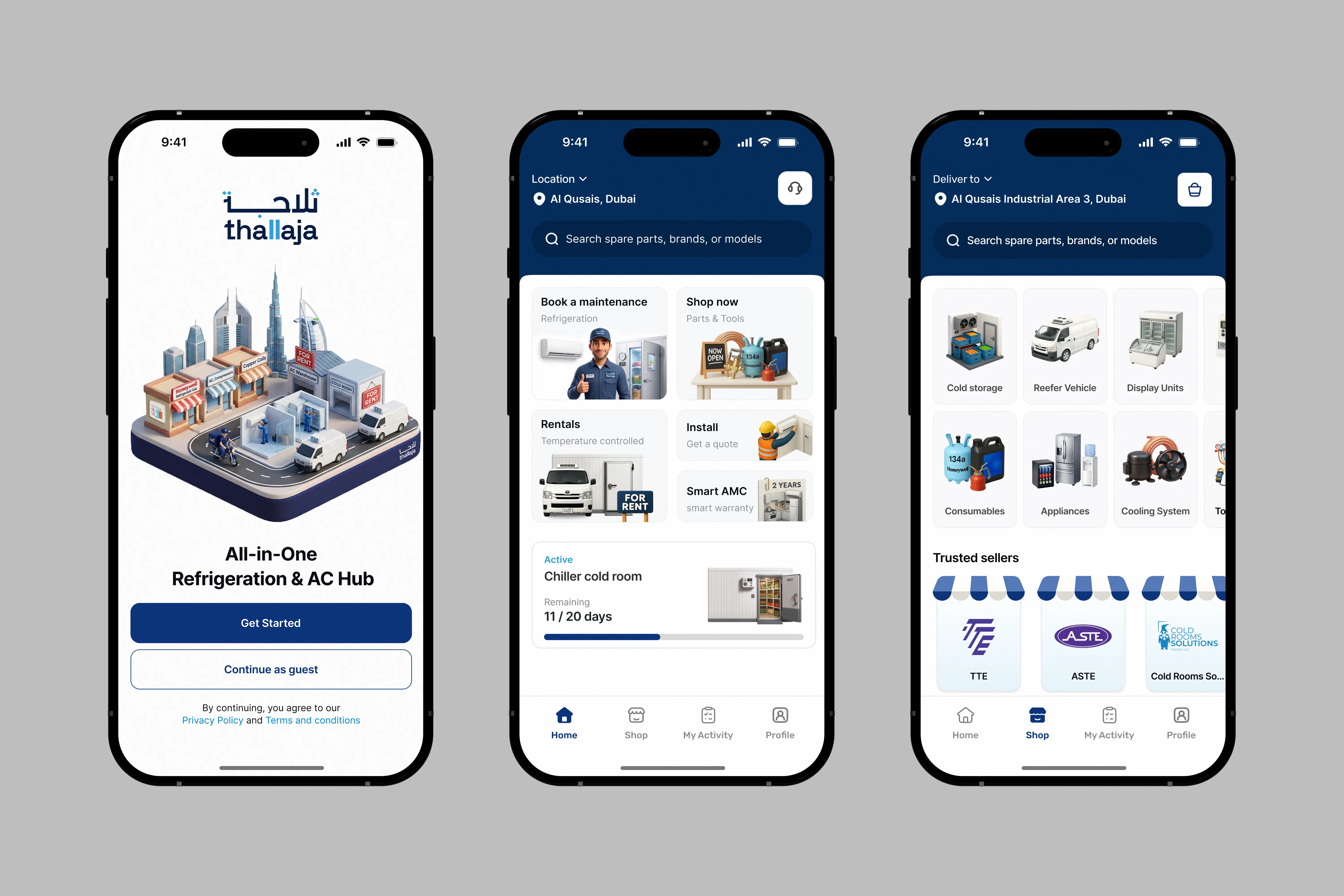
Thallaja is a unified digital platform for refrigeration, cold storage, and air-conditioning operations across the Middle East.

the app bring all maintenance, rentals, spare parts, installations, and AMC services into a single, easy-to-use system designed for both businesses and technicians.

Instead of managing multiple vendors, calls, and manual processes, customers can manage their cold-chain needs end-to-end from one platform. With on-demand services, a growing e-store, and real-time operational visibility, Thallaja helps businesses reduce downtime, improve efficiency, and keep critical cooling systems running reliably.

Thallaja was designed to centralize these workflows into one connected digital ecosystem for the refrigeration and air-conditioning industry, helping businesses improve operational visibility, coordination, and service efficiency.

The product is

Thallaja is a mobile app for B2B Cold Room Refrigeration & Air Conditioning industry platform. Mainely designed and builded for B2B customer who have the business related to Food, Pharma, Boutique industry in all over UAE.

We have found out the loop holes in the business that has been circling round last decades, after being the digital presence is evolved but this industry lost its presence for expample if a cold room operator want to get service of their cold storage unit ( warehouse/room )

The core problem is.
They will call the cold room builded team and ask them to do the service or they search in google "best cold room serivce and maintanence team ).Businesses often rely on disconnected vendors, manual coordination, WhatsApp communication, and offline processes for maintenance, spare-parts procurement, rentals, installations, and AMC management.

Called them, Ask them to come for service and do the work, then done and alast disapper.
the records were all in paper… quote, bills, invoice. ( and a whole team need to involve of this )

to simplitly the work load for the them. we builded this app to solve all problems.

Thallaja is a mobile app for B2B Cold Room Refrigeration & Air Conditioning industry platform. Mainely designed and builded for B2B customer who have the business related to Food, Pharma, Boutique industry in all over UAE.

We have found out the loop holes in the business that has been circling round last decades, after being the digital presence is evolved but this industry lost its presence for expample if a cold room operator want to get service of their cold storage unit ( warehouse/room )

The core problem is.
They will call the cold room builded team and ask them to do the service or they search in google "best cold room serivce and maintanence team ).Businesses often rely on disconnected vendors, manual coordination, WhatsApp communication, and offline processes for maintenance, spare-parts procurement, rentals, installations, and AMC management.

Called them, Ask them to come for service and do the work, then done and alast disapper.
the records were all in paper… quote, bills, invoice. ( and a whole team need to involve of this )

to simplitly the work load for the them. we builded this app to solve all problems.

Thallaja is a mobile app for B2B Cold Room Refrigeration & Air Conditioning industry platform. Mainely designed and builded for B2B customer who have the business related to Food, Pharma, Boutique industry in all over UAE.

We have found out the loop holes in the business that has been circling round last decades, after being the digital presence is evolved but this industry lost its presence for expample if a cold room operator want to get service of their cold storage unit ( warehouse/room )

The core problem is.
They will call the cold room builded team and ask them to do the service or they search in google "best cold room serivce and maintanence team ).Businesses often rely on disconnected vendors, manual coordination, WhatsApp communication, and offline processes for maintenance, spare-parts procurement, rentals, installations, and AMC management.

Called them, Ask them to come for service and do the work, then done and alast disapper.
the records were all in paper… quote, bills, invoice. ( and a whole team need to involve of this )

to simplitly the work load for the them. we builded this app to solve all problems.

I contributed

I worked in the entrie workflow of this project end-to-end as a product designer. I worked closely with founder building everthing from 0. I made a key decisions and ideas in the design and worked closely with the developer's to build this complex app upuntill launch. I goals is to take this as a challege and break the ice to bring all from real world to live app.

With in 8 months time frame, we have launched our app.
Design, product management, handoffs, stakeholder management is the key skill and area which i masters.

I made the design system as well to build this apps smooth scalable and efficitent design system for designers and developers.

Inorder to create a flow, the mindset to change from Product designer to a site research is what makes me to think beyound design.

To be able to understand the industry and crafting the build is what makes me exciting.

I worked in the entrie workflow of this project end-to-end as a product designer. I worked closely with founder building everthing from 0. I made a key decisions and ideas in the design and worked closely with the developer's to build this complex app upuntill launch. I goals is to take this as a challege and break the ice to bring all from real world to live app.

With in 8 months time frame, we have launched our app.
Design, product management, handoffs, stakeholder management is the key skill and area which i masters.

I made the design system as well to build this apps smooth scalable and efficitent design system for designers and developers.

Inorder to create a flow, the mindset to change from Product designer to a site research is what makes me to think beyound design.

To be able to understand the industry and crafting the build is what makes me exciting.

My Role

As the Product Designer, I led the creation of the design system from research to execution.

My responsibilities included:

  • Design system planning

  • UX and UI design

  • Component creation

  • Token structuring

  • Documentation

  • Design consistency

  • Developer collaboration

why it matters
  1. 5 Modules

Creating unified visual and interaction patterns across every module to ensure a predictable and seamless user experience.

  1. Fully digitalize

Building flexible foundations that support future product expansion, new modules, and evolving operational requirements.

  1. Every records in your app

Reducing repetitive design and development work through reusable components, tokens, and standardized patterns.

  1. Ease of use

Improving alignment between design and development teams with a shared system language and structured documentation.

To view the full case study, please access in the desktip!

Behind the screen..

I took this in my entire product cycle

• founder discussions

• field understanding

• operational mapping

• iterative product decisions

• internal reviews

• no benchmark product

• multiple service models

• unclear business evolution

• changing requirements

• balancing ops and UX

As Thallaja expanded across multiple operational modules, maintaining consistency and scalability became increasingly difficult. Different workflows, repeated UI patterns, and fast product growth created design debt and slowed down development. The goal of the design system was to create a unified foundation that improves consistency, speeds up workflows, and supports long-term product scalability.

Solution

Design principles

We had accomplished a lot of user research up until this point and my concern was that as we developed this design system, we would lose sight of the why behind our decisions.

Our team developed a set of design principles that aligned with our initial research to fall back on whenever we would get stuck or if a decision required extensive discussion.

System Architecture

Before building the design system, we structured the entire system architecture to organize components, modules, documentation, and workflows. This helped create a centralized foundation for both design and development.

The goal was to simplify collaboration, reduce confusion across tools, and create a scalable structure for future product growth.

Tokens

01
Token architecture

Two-layer system: primitives hold raw values, tokens hold semantic meaning

Growing from a company of 30 to 200 in less than a year has led to the rapid development of our products used by healthcare organizations. In the time it took to create three unique products, each product had a unique look, feel, and experience.

As our team got together to create a unified brand and voice - we found ourselves at an impasse, an unnerving realization that we perhaps had wandered too far and needed to turn back.

02
Color primitives

Raw color values the source of truth for all tokens. Never used directly in components.

In a separate file, we created a colour guide. Each colour would be listed as a RGBA and HEX value. To comply with accessibility guidelines, specifications were given to colours that would be primarily used as foreground colours and background colours. Our goal was to hit WCAG Level AA 1.4.3 Colour Contrast at a minimum. We worked with our current branding and marketing designs to create colour combinations that passed and exceeded this accessibility guideline.

03
Color tokens

Semantic layer tokens reference primitives. Change the primitive, everything updates.

Growing from a company of 30 to 200 in less than a year has led to the rapid development of our products used by healthcare organizations. In the time it took to create three unique products, each product had a unique look, feel, and experience.

As our team got together to create a unified brand and voice - we found ourselves at an impasse, an unnerving realization that we perhaps had wandered too far and needed to turn back.

04
Typography scale

Rubik for display + headings · Inter for body, captions, UI. 58 tokens across 9 style groups.

We began with typography to describe when and how fonts should be displayed to a user. To comply with usability guidelines, we mapped out the HTML tags for each of the fonts. Depending on the project, developers would choose between pixels and rem. We made sure to accommodate both and allow for conversions when necessary.

Buttons

organisms

Organisms are the most complex components. They include molecules and atoms.

High Fidelity Designs

Component

In each unique project, we would import our design system and use it to create our mock ups. This was done so that developers would not have to dig around the file to find whatever component they were looking for. It was a bit of a challenge introducing Figma to some teams so we had to run a few Figma 101 workshops to help people get familiar with the application. Once our teams saw that the designs were annotated and how easy it was to switch between states with variants, it made us feel like all the work we had put behind it was worth it.

Design screens

In each unique project, we would import our design system and use it to create our mock ups. This was done so that developers would not have to dig around the file to find whatever component they were looking for. It was a bit of a challenge introducing Figma to some teams so we had to run a few Figma 101 workshops to help people get familiar with the application. Once our teams saw that the designs were annotated and how easy it was to switch between states with variants, it made us feel like all the work we had put behind it was worth it.

Impact

We published this design system to our development teams and found that it was received warmly. Overall, teams felt like there was less guessing and assumptions being made, and a more concrete design. One of the feedback we received was that there felt like less pressure to get things done about the user interface which left us more time to think about the usability of our design.

An unexpected impact was that we were able to develop demos for sales faster. Something that used to take a lot of time and coordination was made easier by pulling and modifying components in our design system.

Retrospective

I found this project quite challenging at the start as it was done at the same time as I led another client facing project. But I saw the advantages we would have as a team going forward if this were put in place and exhausted my efforts to make this design system a reality. In the end, I think it was definitely worth it.

From decades of messy operations to one clear digital system

The whole process of keeping things cold during transportation and storage is really complicated.. In the Middle East the tools people use to do this are not very good and are old.

Thallaja.com was made to solve one problem.

There was no system to manage everything that has to do with keeping things cold from start to finish.

We did not just make parts of the system without thinking about how they work together. Instead we thought of Thallaja.com as a system for managing cold chain operations. Our goal was to bring all the parts of the process together in one place without making it harder for people to use when they are in a hurry and need to save money.

This is how we came up with a plan to make Thallaja.com work in a way. We made it so that things, like maintenance, rentals, buying parts, installations and maintenance contracts work as separate parts but they all follow the same rules and use the same information and logic throughout the system. This makes cold chain operations easier to manage on Thallaja.com.

Outcome

Product design
UX Reasoning
Business Logic
System impact
Category selection
Issue capture
Asset identification
Service intent
Service intent
Design principle
  1. Progressive disclosure.

  2. Reduce cognitive load.

  3. Structured data improve operations.

  4. Operational Transparency.

  5. Guided Inputs.

Lumnia

Lumnia

Prism

Prism

Vertex

Vertex

Research Documents

3 projects

Hover to explore
Category selection
Issue capture
Asset identification
Service intent
Service intent
• what product is
• why it exists
• what you contributed
• why it matters
Approach

• founder discussions

• field understanding

• operational mapping

• iterative product decisions

• internal reviews

• no benchmark product

• multiple service models

• unclear business evolution

• changing requirements

• balancing ops and UX

Strategic decisions

For your product, I suggest:

  1. Headline

  2. Overview

  3. Why this product needed to exist

  4. Wearing multiple hats (your concept)

  5. Product ecosystem

  6. Key product decisions

  7. Challenges

  8. Solution chapters

  9. Impact

  10. Reflection


Category selection
Issue capture
Asset identification
Service intent
Service intent
Note:

This project includes internal flows, operational logic, and business decisions currently used in production.

From fragmentation to a single operational backbone, Thallaja achieved measurable business impact.

28%

Service booking friction

2.1x

Technician readiness

2.1x

Operational blind spots

37%

Cross-service reuse

“By surfacing guardrails in-product, Galilee cut confusion and made outcomes predictable for our customers.”

57%

time savings

48%

fewer approval loops

41%

less manual work

From fragmentation to a single operational backbone, Thallaja achieved measurable business impact.

28%

Service booking friction

2.1x

Technician readiness

2.1x

Operational blind spots

37%

Cross-service reuse

“By surfacing guardrails in-product, Galilee cut confusion and made outcomes predictable for our customers.”

57%

time savings

48%

fewer approval loops

41%

less manual work

Outcome

As a result we graded one of the best app in app store

The whole process of keeping things cold during transportation and storage is really complicated.. In the Middle East the tools people use to do this are not very good and are old.

Thallaja.com was made to solve one problem.

There was no system to manage everything that has to do with keeping things cold from start to finish.

We did not just make parts of the system without thinking about how they work together. Instead we thought of Thallaja.com as a system for managing cold chain operations. Our goal was to bring all the parts of the process together in one place without making it harder for people to use when they are in a hurry and need to save money.

This is how we came up with a plan to make Thallaja.com work in a way. We made it so that things, like maintenance, rentals, buying parts, installations and maintenance contracts work as separate parts but they all follow the same rules and use the same information and logic throughout the system. This makes cold chain operations easier to manage on Thallaja.com.

Note:

This project includes internal flows, operational logic, and business decisions currently used in production.

Let's explore the design process

Discovery

Design Mode

Deep

Findings

AI Testing

Scan & Experience